← All research topics
AI and Machine Learning Applications
How much data does a model really need? Classical machine learning versus deep learning.
Background
Most computer vision work in agriculture uses CNN-based deep learning, which needs thousands of expert-labelled images and heavy computing. Many farms and projects cannot provide that.
Objectives
- Find the minimum number of training images that gives a reliable weed classifier.
- Compare feature-based machine learning with deep learning (YOLO) and choose by the data available.
Methodology
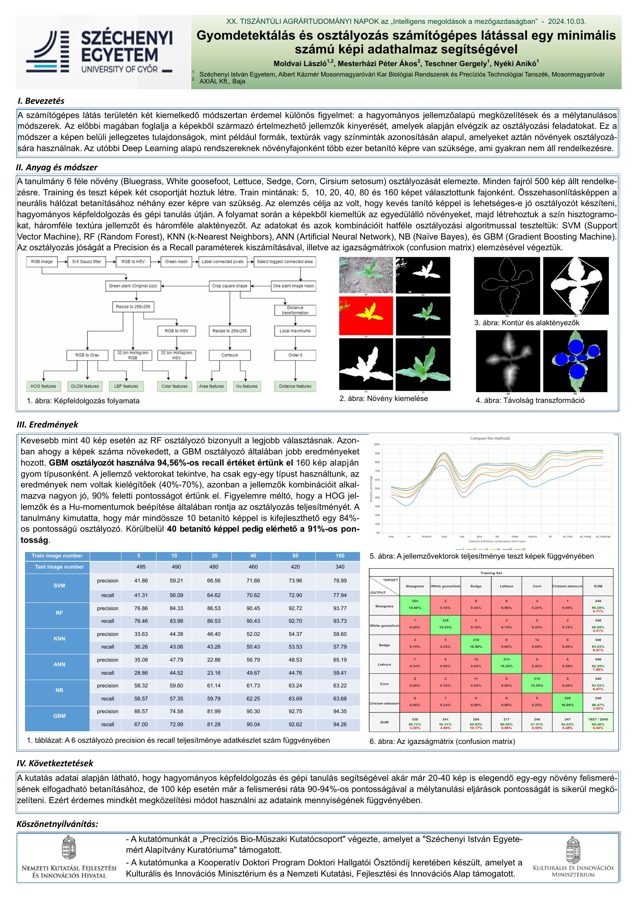
- Shape, distance-transform, colour-histogram and texture features, alone and combined, with six classifiers (SVM, random forest, KNN, ANN, naive Bayes, gradient boosting) on 5, 10, 20, 40, 80 and 160 training images per weed type.
- YOLO object detection with augmentation for single-class weed detection in UAV tiles.
Results
- With 160 images per class gradient boosting reached 94.56 % recall; about 10 images gave 84 % accuracy and about 40 images 91 %.
- Combinations of features clearly beat single feature types (90 %+ versus 40–70 %).
- For very small datasets random forest was best; with more images gradient boosting took over.
Related publications
2024Q2
Weed Detection and Classification with Computer Vision Using a Limited Image Dataset
L. Moldvai, P. Á. Mesterházi, G. Teschner, A. Nyéki
Applied Sciences 2024, 14(11), 4839
Abstract
How few training images are enough? Traditional feature-based computer vision (shape, distance-transform, colour-histogram and texture features) with six classifiers was tested on 5–160 images per weed type in a four-class problem. With 160 images per class a 94.56 % recall was reached, close to deep-learning accuracy with a tenth of the data.
DOI: 10.3390/app14114839
2024
Weed detection in agricultural fields using machine vision
L. Moldvai, B. Ambrus, G. Teschner, A. Nyéki
BIO Web of Conferences 2024, 125, 01004
Abstract
An overview of RGB-image-based weed detection and automated weed control, and how accurate targeting of weeds lowers production costs and chemical use in precision agriculture.
DOI: 10.1051/bioconf/202412501004FAO AGRIS
2026conference proceedings, not refereed
UAV-Based Detection and Precision Management of Cirsium arvense: An End-to-End Workflow from Deep Learning to Variable-Rate Spraying
L. Moldvai, P. Á. Mesterházi, G. Teschner, A. Nyéki
Proceedings of the 17th International Conference on Precision Agriculture (ICPA) and 11th Brazilian Congress on Precision and Digital Agriculture, Porto Alegre, Brazil, 13–15 July 2026
Abstract
An end-to-end workflow for detecting creeping thistle (Cirsium arvense) in UAV imagery and turning the detections into sprayer-compatible management zones. A single-class YOLO model trained on 800 annotated tiles (augmented to 13,280 images) reached mAP@0.5 = 78.97 % and F1 = 77.2 %. Herbicide was needed on only 32.43 % of the field, a 67.57 % reduction compared with full-area spraying.
Conferences
Poster3 October 2024
Gyomdetektálás és osztályozás számítógépes látással egy minimális számú képi adathalmaz segítségével
XX. Tiszántúli Agrártudományi Napok – „Intelligens megoldások a mezőgazdaságban”, Debrecen, Hungary
Poster (in Hungarian): weed classification with classical computer vision from only 5–160 training images per species; 94.56 % recall with 160 images.
Poster (PDF)Related article